|
|
|
|
|
 |
|
|
|
|
|
|
|
|
| |||||||||||||||||||||||||||||
| Signatures on this item | |
| *The value given for each signature has been calculated by us based on the historical significance and rarity of the signature. Values of many pilot signatures have risen in recent years and will likely continue to rise as they become more and more rare. | |
| Name | Info |
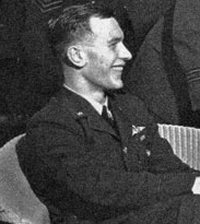 Squadron Leader John Beard (deceased) *Signature Value : £60 | Beard joined the RAF Volunteer Reserve in 1937 and completed his flying training before being called up at the outbreak of the Second World War. After joining No. 609 Squadron, he transferred to No. 249 Squadron in 1940 and flew Hurricanes during the Battle of Britain, claiming several enemy aircraft before being awarded the Distinguished Flying Medal (DFM). He was later shot down and wounded over Kent but returned to service after recovering, receiving his commission in December 1940. Following further flying duties, Beard became an instructor at No. 52 Operational Training Unit and later played an important role in developing air gunnery training at the Central Gunnery School, where he was involved in testing new armament equipment. Awarded the Air Force Cross (AFC) in 1945, he went on to serve in training and administrative roles, including with No. 229 Group in India, before leaving the RAF as a Squadron Leader. In civilian life he worked in the furniture industry before establishing an electrical engineering company producing test equipment for motor manufacturers. He died on the 21st of November 2000. |
| Wing Commander John Beazley (deceased) *Signature Value : £60 | Called up at the outbreak of the Second World War, he completed his pilot training and joined No. 249 Squadron, flying Hurricanes during the Battle of Britain. He achieved several victories, including enemy fighters and bombers, before being wounded in combat in September 1940. After recovering, Beazley returned to the squadron and took part in the defence of Malta, where he flew more than 200 operational sorties during some of the most intense fighting of the war. He later commanded No. 249 Squadron before serving on staff duties and returning to operations with No. 89 Squadron in North Africa and Southeast Asia, flying Beaufighters. Awarded the Distinguished Flying Cross (DFC) in 1944 for his courage and leadership, he later commanded an operational airfield in Ceylon. Choosing to continue flying rather than pursue further promotion, Beazley transferred to Transport Command after the war, flying Dakotas in Europe and overseas before leaving the RAF in 1946. He died on the 13th of June 2011. |
  Wing Commander Tom Neil DFC* AFC (deceased) *Signature Value : £50 | Tom Neil was born on 14th July 1920 in Bootle, Lancashire. Tom Neil (also to become known in the RAF as 'Ginger') joined the RAFVR in October 1938 and began his flying training at 17 E and RFTS, Barton, Manchester. Tom Neil was called up on the 2nd os September 1939 being sent to 4 ITW, Bexhill in early November. On 1st December 1939, he was posted to 8 FTS and on completion of the course he was commissioned and posted to 249 Squadron in May 1940 flying Hurricanes just before the start of the Battle of Britain flying from North Weald. On 7th September 1940, Tom Neil encountered and claimed a Bf109 destroyed. On the 11th an He111, on the 15th two Bf109s and a Do17 destroyed and another Do17 shared, on the 18th an He111 damaged and on the 27th a Bf110 and a Ju88 destroyed, a Bf110 probably destroyed and a Ju88 shared. On 6th October Tom Neil shared a Do17, on the 25th claimed a Bf109 destroyed, on the 27th a Do17 probably destroyed, on the 28th a Ju88 shared and on 7th November a Ju87 and two Bf109s destroyed. He was awarded a DFC on 8 October, but on 7 November, after claiming 3 victories over the North Sea off the Essex coast, he collided in mid-air with Wing Commander Francis Beamish and his aircraft lost its tail. He baled out of his Hurricane unhurt, Beamish force-landing unscathed. Tom received a Bar to his DFC on 26 November, and on 13 December was promoted flight Commander. The squadron was posted to Malta in May 1941, flying off HMS Ark Royal on the 21st. During a summer of frequent scrambles, he claimed one further victory in June, while on 7th October he led a fighter-bomber attack on Gela station, Sicily. He departed the island in December 1941, returning to the UK via the Middle East, South and West Africa, and Canada, finally arriving in March 1942, when he became tactics officer with 81 Group. A spell as an instructor at 56 OTU, before being posted as a flying liaison officer with the 100th Fighter Wing of the US 9th Air Force in January 1944. He managed to get some flying in over France with this unit, claiming a share in 6 aircraft destroyed on the ground before D-Day, and a dozen or so more later, plus a number of other ground targets. In January 1945 he was sent to the school of Land/Air Warfare as an instructor. In March 1945 he was posted out to Burma, where he undertook some operations with 1 Wing, Indian Air Force, to gain experience of the operations in this area. Returning to the UK in April, he resumed instructing at the school until the end of the year. In January 1946 he attended the Empire Test Pilots School, undertaking No.4 short course and No.5 course, a total of 18 months. Posted briefly to Farnborough, he sought a move to Boscombe Down, where he stayed for some 3 years. In 1948 in went to Wright-Patterson AFB, Dayton, Ohio, to take part in the first high altitude pressure suit experiments, as a precursor to the aerospace programme. 1950-51 he was a staff officer at HQ, Fighter Command, while in 1952 he attended the staff college at Bracknell. He was then given command of 208 Squadron in Egypt, which he led until 1956, leaving just before the Suez operation. He returned to the UK to become W/Cdr Operations, Metropolitan sector, until 1958, when he attended the flying college at Manby. He went to the British Embassy in Washington for 3 years from 1959, returning to the Ministry of Defence but retiring from the service as a Wing Commander in 1964. Meanwhile he had added the US Bronze Star to his decorations in august 1947, and an AFC in January 1956. Tom Neil died on 11th July 2018. |
|
Contact Details |
|
Sign Up To Our Newsletter!
This website is owned by Cranston Fine Arts. Torwood House, Torwoodhill Road, Rhu, Helensburgh, Scotland, G848LE Contact: Tel: (+44) (0) 1436 820269. Email: cranstonorders -at- outlook.com
|
|
|