
Please note that our logo (below) only appears on the images on our website and is not on the actual art prints.

|
|
Roland Beamont Print and Clipped Signature Pack.
PCK2824. Roland Beamont Print and Clipped Signature Pack. Clipped Signature and Print Pack.
Items in this pack :
Item #1 - Click to view individual item
DHM1922APB. An Early Bath by Ivan Berryman. In the early evening of the 18th of July 1941, following coastguard reports of an enemy aircraft in their vicinity, two Hurricanes of 87 Sqn on detachment at the Airfield at St Mary's, Scilly Isles were scrambled to an area some 30 miles south west of the Scilly Isles where they intercepted a lone Heinkel He111. Alex Thom was the first to attack, his windscreen being sprayed with oil as his rounds tore into the Heinkel's starboard engine. Breaking away, his wingman F/O Roscoe now took over the chase, but the German bomber was already mortally wounded and was observed to alight onto the sea where upon the crew immediately took to their life raft as the Heinkel began to sink beneath the waves just minutes later, Thom circled overhead until he saw the motor launch arrive to pick up the German aircrew before returning back to St Mary's. Signed by Flight Lieutenant Alex Thom DFC. Small limited edition of 20 artist proofs. Image size 12 inches x 8 inches (31cm x 20cm)
Item #2 - Click to view individual item
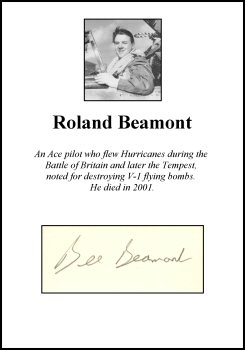
CLP0122. Clipped Signature - Roland Beamont. An Ace pilot who flew Hurricanes during the Battle of Britain and later the Tempest, noted for destroying V-1 flying bombs. He died in 2001. Clipped signatures are usually obtained from prints or publications that have been signed in person. Often, signatures have been rescued - or clipped - from prints that have been damaged in another area. Clipped Signature.
Website Price: £ 125.00
To purchase these prints individually at their normal retail price would cost £205.00 . By buying them together in this special pack, you save £80
All prices are displayed in British Pounds Sterling
|
|
|
| Signatures on this item | | *The value given for each signature has been calculated by us based on the historical significance and rarity of the signature. Values of many pilot signatures have risen in recent years and will likely continue to rise as they become more and more rare. | | Name | Info | 

Flight Lieutenant Alexander Henry Thom DFC (deceased)
*Signature Value : £45 (matted)
| Born in Perth, Scotland, Alex Thom joined the RAFVR on June 24th 1939 and flew at the weekends at 11 EARFTS Perth. At the outbreak of World War Two, Thom was called up for full time service with the Royal Air Force and was posted to 3 ITW at Hastings on October 2nd 1939, moving to 15 EFTS at Redhill on April 29th 1940 and on June 15th moved again to 15 FTS, initially at Brize Norton and later to Chipping Norton. Alex Thom went to 6 OTU on September 29th at Sutton Bridge where he converted to Hawker Hurricanes and joined 79 squadron stationed at Pembury only for a short period when he was transferred to 87 Squadron on October 6th 1940, moving with the squadron on the 31st of October to their new base at Exeter. He achieved the rank of Pilot Officer on the 3rd of December 1941. During his time at Exeter he was also based on the Scilly Isles and on one occasion after shooting down an enemy bomber the crew bailed out over the sea. Alex Thom circled the downed German crew who were in a life raft until a motor launch came and picked them up. Thom would later meet the crew and was given a flying helmet by the German pilot, an item he still has today. Alex Thom was appointed B Flight commander on 10th July 1942 and was awarded the DFC on the 14th August 1942. At this time he was credited with two enemy aircraft destroyed and a probable He111. On the 19th of August 1942 while supporting the ground forces at Dieppe, his Hurricane (LK - M) was hit by ground fire and lost oil pressure. He managed to limp back to England where he made a forced landing at East Den. Thom managed to get back to his airfield as a passenger in a Master flown by Flt Sgt Lowe and immediately took off again in Hurricane (LK - A) back to Dieppe where he proceeded to strafe enemy positions. On the 1st of October 1942 he became F/O. In November 1942, 87 Squadron was transferred to North Africa. They were transported by ship to Gibraltar where the squadron flew sorties, and then onto North Africa. Thom was posted away from the squadron to be a flying control officer at Bone. He returned to 87 Squadron which was then based at Tongley and took command on June 27th 1943. He was again posted away from the squadron on September 27th returning to the UK with the Rank of Flight Lt. Thom became an instructor with 55 OTU at Annan on November 17th moving to Kirton in Linsay on March 12th 1944 to join 53 OTU. He was appointed Flight Commander Fighter Affiliation Flight at 84 (Bomber) OTU at Husbands Bosworth on May 19th 1944 and remained there until October 10th when he went to RAF Peterhead as Adjutant. His final posting was to HQ13 Group, Inverness on May 8th 1945 as a Staff Officer and retired from the RAF on December 4th 1945 as a Flight Lt. He died on 10th January 2016. |
| Signatures on item 2 | | *The value given for each signature has been calculated by us based on the historical significance and rarity of the signature. Values of many pilot signatures have risen in recent years and will likely continue to rise as they become more and more rare. | | Name | Info | 

Wing Commander Roland Bee Beamont CBE DSO DFC DL (deceased)
*Signature Value : £55 (matted)
| One of World War IIs great characters, Bee flew Hurricanes with 87 Squadron, later leading a Tempest Wing. He had 8 victories plus a further 32 VIs destroyed. After the war he became a highly respected Chief Test Pilot.Wing Commander Roland Beamont, one of the RAFs top buzz bomb interceptors, was born in Enfield England on August 10, 1920. Educated at Eastborne College, Beamont accepted a short service commission with the Royal Air Force in 1938. He commenced flying in 1939 at the the No. 13 Reserve Flying School at White Waltham. His initial duty was with the Group Fighter Pool at St. Athan where he learned to fly the Hurricane. Beamont was soon posted with the No. 87 Squadron which was part of the Advanced Air Striking Force in France. Seeing action in both France and Belgium prior to the Allied withdrawl, Beamont rejoined 87 Squadron in England during the Battle of Britain. In the spring of 1941 Beamont was awarded the Distinguished Flying Cross after destroying five enemy aircraft. As Commanding Officer of 609 Squadron, Beamont pioneered both day and night ground attack missions utilizing the Typhoon. Beamont was credited with destroying 25 trains in a three month period. He was then made responsible for organizing and commanding the first Tempest Wing at Newchurch. Three days after D-Day Bearnont shot down an Me-109, marking the first aerial combat victory for the Hawker Tempest. In the summer of 1944 Beamont destroyed 32 buzz bombs prior to leading his wing to a Dutch Airfield at Volkel on the Continent. In October of 1944 Beamont was shot down during a ground attack mission over Germany, and he remained a prisoner of war until wars end. Following repatriation Beamont became an experimental test pilot with the Gloster Aircraft Company, which had developed the RAFs first jet aircraft. Turning down a permanent commission with the RAF, Beamont then joined English Electric Company in Wharton as the Chief Test Pilot for the B3/45 (Canberra) jet bomber program. He managed all prototype testing on the Canberra, and in the process set two Atlantic speed records. Later Beamont was involved with the supersonic P1/Lightning program, and became the first British pilot to fly at twice the speed of sound. From 1965 until 1970 he was a founding member of Britains highly succesful Saudi Arabian export program. For several years prior to his retirement in 1979, Beamont was Director of Operations for British Aerospace and Panavia where he was in charge of flight testing for the Tornado. Since his retirement Beamont has authored nine books, and published numerous magazine articles. He is a Fellow of the Royal Aeronautical Scociety and an Honorary Fellow of the Society of Experimental Test Pilots in America. He died 19th November 2001. |
|


